Friday, 11 November 2011

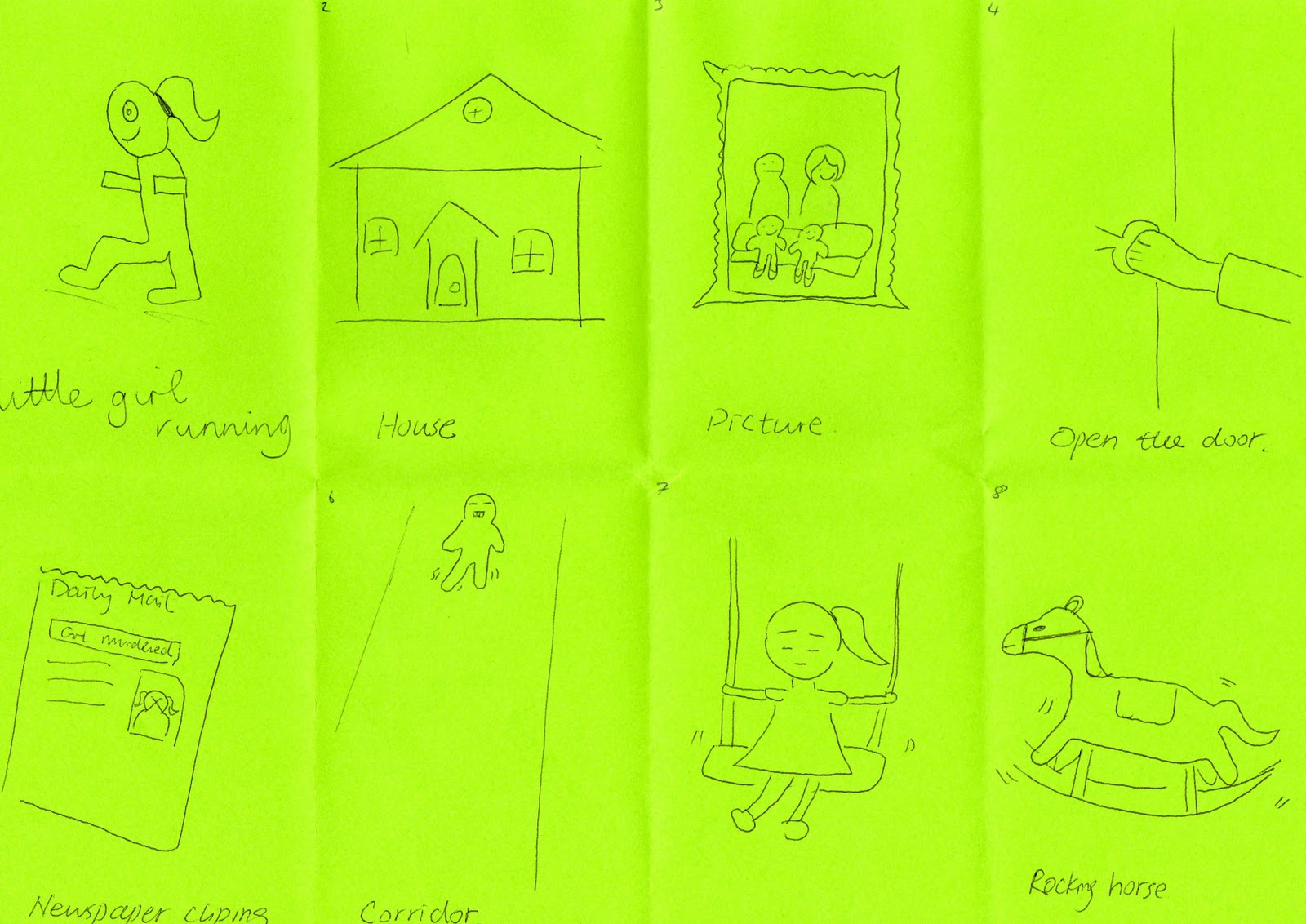
Character based title sequence storyboard


Here are some of our ideas for a title sequence which would relate to the character
This is actually inspired by the title sequence of the film Se7en.
Here we tend to use close ups of different single props which are related to our plot.
Since our film is going to be children-based, we will have a shot with a little girl running at the start.
Then we will put close ups like the girl's house, unhappy eerie family framed photo, stranger opening door, newspaper clips which tell the murder of the little girl etc.

The title sequence will end with a shot showing a hanging rope which means there will be another character being killed in our film due to the little girl's death.

Image based title sequence storyboard


These are our ideas for using images for a title sequence which relate to the genre of Ghost
Here we tend to have different single shots to show the surroundings of our film's location,
for example mirror, television, corridor, vintage clock in the location; and misty garden, gloomy sky with heavy clouds to make our audience to have a feeling that they are already surrounded by a mysterious atmosphere.

At the end of the title sequence, we will have a blurry shot with a stranger walking towards the camera but never make it clear that who the person is, this is also a strategy to arouse audience's interest in watching the whole film.

Thursday, 10 November 2011

Isabel Wong Textual Analysis

Film Name: The Sixth Sense
Sub Genre: Ghost

  Throughout the whole film, there are various types of camera shots to illustrate the threats ahead and make the audience thrilled. For example, there are a lot of close ups of Cole's footstep in a dark area, this makes me wonder what is in front of Cole and what will happen next and such shots can create the fear of the audience directly because unknown makes people anxious. There are also many low angle shots, long shots and POV shots in the film, for instance, the film tends to show Cole's eyesight when he is walking towards where the spooky objects are. POV shot is commonly used in horror film since it makes the whole scene seems real to the audience, the audience may feel like experiencing the whole thing with the character or they may assume they are the characters themselves. Besides POV shot, the film contains quite a lot of long shots, like when Cole is walking through the long corridor in the dark, the long shots create the vulnerable image of Cole because the use of long shots particularly shows the relatively small body of Cole which makes him looks weak.
  There is one part that Cole meets the sick girl in his own tent, right before he goes back to his tent and tries to communicate with the girl, the film made use of various kinds of camer shot to create the thrilling atmosphere, there is canted angle-long shot which is showing the dark corridor, then there is a POV shot whiching pretending the eyesight of Cole on the dark living room, then it comes to a close up of Cole's fear face, the combination of these camera shots creates the fear of the audience accurately.
 
  The film made use of dim light and dark lighting to portray the mysterious and scary atmosphere. When Cole meets the sick lighting in front of his tent, it is almost entirely dark in the background whilst there is only some red light from the tent reflects on Cole's fear face, such lighting makes the audience feel scary.

  Similar to most horror film, the film has tense and horrifying background music in the opening with violins creating some screeching sound which makes the audience chill. When Cole meets the suicide woman, silence in the scene creates an extreme fear to the audience, when the woman walks pass Cole, there is suddenly a "Bang" sound which makes people jump.

  The scary parts of the film are usually located at corridors, stairs where something can hide at an invisible dark corner. At the beginning of the film, Anna is at the dark liquor cabinet picking red wine, since it is located at the bottom of the house, and seems it's hard to grab enough light, such environment creates the fear of the audience and makes them wondering if there will be anything coming out at the next moment. Since there are plenty dark corners in the liquor cabinet, it leaves enough rooms for something to hide so it further makes the audience fear of something is going to come out.

  The film focuses on a lot of props to create fear, it gives many close up shots on the things that sharpen the personalities of the characters. For example, there are close up shots on a dim light bulb, candles to illustrate the mysterious atmosphere by emphasizing the dim light. The tiny statues of Jesus, Maria give to evidence of Cole can connect with the paranormal objects.

  The film has followed several conventions of my sub-genre, including thing moving on its own where we can find the example in the part Cole meets the sick girl in his tent. The haunted house is even implied to this film as there are quite a lot paranormal encounters of Cole happen in his own house. Also, the film made use of horrible make up to show how the ghosts are killed by showing their bleeding head, pale face etc.

  I think the scariest part of the film is Cole meets the sick girl in his tent. Because at the very beginning of the part, Cole is hiding inside the "safety zone" he assumed, but suddenly the clips on the tent remove automatically and the tense background music gives evidence that something is going to show up which makes my heart beats faster and faster. Then, Cole runs out of the tent and walks pass the dark corridor, the combination of various camera shots creates the fear that makes the audience can hardly breath, there are close up of Cole's fear face, canted angle-long shot of the dark corridor and even POV shot of Cole, these camera shots trap the audience to watch what is going to happen next and unable them to escape from the scene even if they're terrified.
   

Laurie Dyche Founation Portfolio Research: Textual Analysis


Foundation Portfolio Research
My sub-genre is ‘Ghost’ so in order to get some ideas for my own horror film, I watched Gothika. Even though I have seen this film before it never fails to make me jump and the first time I watched it it gave me nightmares so I thought it would be a good film to watch and pick up some ideas.
The camera shots varied to portray the victim and threat in the film. At the very start of the film there is a close up of Chloe’s face when she is speaking about what happened to her; this is so that the audience only focus is on her and you aren’t distracted by the surroundings so you can listen to what she is saying. It is also so that we can see the emotion on her face clearly and feel sympathy for the character because she looks distressed and upset. Later on in the film, when Miranda is in the shower, the camera illustrates what Miranda can see when she sees distorted faces of the people in the shower. This is so the audience can see what she sees which is effective because the images are frightening and confusing as you don’t know if what you are seeing is just her imagination, the ghost taking over her mind or her eyes playing tricks due to the drugs she’s been given by the hospital. The camera frames the victim by doing close ups of the girl ghost under the bridge because it showed that she was shaking, hurt and you could see that she was crying which engages the audience because you want to find out what is wrong with the girl and find out what happened to her. However, in contrast to this, the girl ghost is also conveyed as the threat because when Miranda is in the shower the camera shows another close up of her face which looked angry and evil which is again engaging to the audience because you become scared of the character as you don’t know what the girl will do next and you want to know why she is so angry and violent towards Miranda.
All through the film there isn’t much light as whenever the film is outside it is at night time. Inside the hospital there is artificial lighting which is always flashing, this makes the scene seem jumpy because you are always afraid of what you can’t see so when the light goes to darkness you don’t know what is there. Due to the little light in this film, you cannot see the actors/actresses face as it casts shadows over their faces which makes all the characters seem suspicious and eerie because you can’t see them clearly.
At the very beginning there is not any music only Chloe talking about what happened to her. This is used because it is very dramatic and also highlights what Chloe is saying as there is no back ground noise to distract. After Miranda and Chloe have a conversation, Chloe suddenly shouts which makes the audience jump because it was so unexpected. When she is carried away by the guards she is screaming and shouting after Miranda which links with the choice of instruments which is then played as Miranda walks away. These are violins and pianos which are used because those instruments typically are related to emotion and sadness.
Gothika is set in a mental asylum which was used to great effect because it creates fear as you a typically afraid of people who have been branded ‘crazy’. The mental asylum is dull and grey with huge gates, locks and lots of security. This again links to fear because it portrays that the people inside have either killed someone or who are mentally unstable.
In the opening scene there aren’t many key props. However, throughout the film there are other props which we see such as the murder weapon (axe), the newspaper article (which is where we find out what happened to her husband), a computer (where Miranda finds the information about the tattoo and what happened to the ghost called Rachel), the cameras in the hospital and the TV screens they appear on, Medical equipment (drugs). All of these things are crucial props because without them the plot wouldn’t be as gripping and wouldn’t flow.
There are conventions of my sub-genre in this film such as flashing lights, the lightening outside, shadows, ghost writing and things moving on their own which i think we should take in consideration when deciding what conventions to put in our film.
The scariest part of the film was when Miranda is in a cell and she bends down to pick something up the ghost is stood right behind her. What makes it so scary is because you don’t expect to see her stood behind her which made me jump. I think I’ll use something similar to this in our film.

Emily Bland Textual Analysis: The ring (certificate 15)


Friday, 4 November 2011

Mind Map

These are the type of things we know that we have to include in our film.
In order to fit the conventions of our sub-genre (ghost), we might have things moving on their own in the film because this is a very popular conventions in ghost films.
We would also like to make our horror film children-based, because children in horror films can always
enhance eerie feeling and even appeal a wider range of audience including adults and teenagers.
So location we are probably using will be somewhere with children, for example nursery, orphanage, playground etc. Kid's evil laughter will be put in the film to create a scary atmosphere.

Since mirrors are commonly used in horror films, we might make use of reflection to portray a sense of mystery before the film reaches its climax. This is to drag audience into the mood of the film, and further enhance the mutual threat since the audience are like exploring what will happen next with victims in the film. It would be a good idea to have some shots of the shadows of props or the victims to create the loneliness and emptiness of the location, thus increase the vulnerability of the victim.

We prefer having dark eyes as make up of the ghost in our film to make it scary.

Final coursework group Emily Bland, Laurie Dyche, Isabel Wong

We have now gone into our groups for our horror film and have decided on the genre of Ghost.